If you manage a food processing or manufacturing facility, oversee a commercial kitchen, or work in healthcare procurement — you’ve probably specified “stainless steel” on a fabrication brief and assumed that covered it. In most cases it does — but the difference between food-safe stainless steel fabrication and standard stainless work is more than just the grade of steel. It’s in the design, the finish, the welding technique, and the experience of the fabricator. Here’s what to look for before you commission any stainless steel work for a food, beverage, or healthcare environment.
Stainless Steel Grades Explained
Most people in the industry know there’s a difference between 304 and 316 stainless. What’s less understood is that you can fabricate from the right grade and still end up with equipment that’s not fit for a food or healthcare environment because of how it was welded, finished, or designed.
For most commercial food, beverage, and healthcare applications, 316 or 316L is the right starting point. But the grade is just that, a starting point.
Why Fabricating Stainless Steel to Food-Grade Standards Is Important
Food-grade fabrication goes well beyond material selection. Every design decision — from how joints are formed to how surfaces are finished — has a direct impact on hygiene performance and compliance. Here’s what good food-grade fabrication addresses:
Internal corners and crevices. Bacteria accumulates anywhere that can’t be thoroughly cleaned. Food-grade design eliminates tight internal corners and uses radius bends to ensure surfaces are fully accessible.
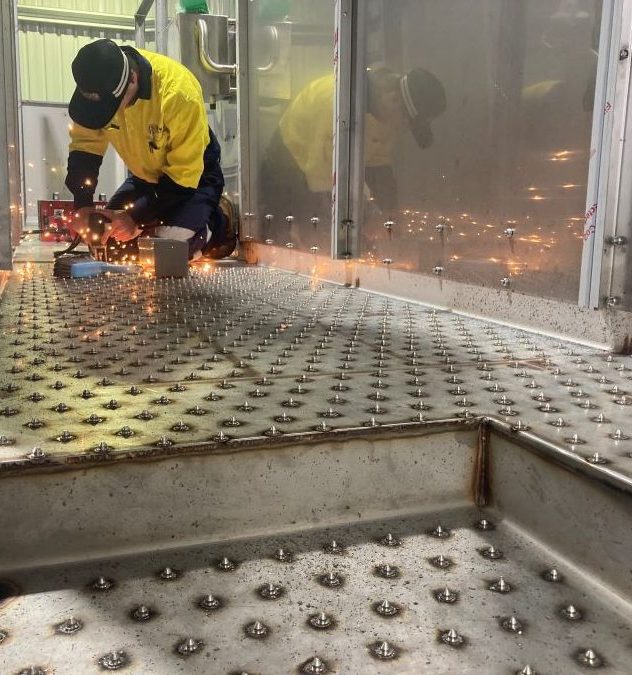
Weld quality and surface continuity. Food-grade welds are ground back and polished to a smooth, continuous surface — removing any irregularity that could harbour bacteria or trap cleaning residue.
Appropriate surface finish. Food-grade work requires a minimum 2B or #4 finish, with electropolishing specified in some applications — ensuring the surface is hygienically clean at the microscopic level, not just visually.
Drainage by design. Equipment that drains properly is equipment that stays clean. Food-safe fabrication accounts for drainage in the design stage, so there’s no pooling of water or cleaning solution.
Compatible materials throughout. All fixings, fasteners, and supports in contact with the stainless need to be compatible — mixing metals causes galvanic corrosion and creates maintenance problems down the line.
What to Check Before Choosing a Food-Grade Stainless Steel Fabricator
Not all fabricators have experience with food-safe or healthcare-grade work. A few straightforward checks will tell you whether a fabricator genuinely understands the requirements:
Experience with food-grade or healthcare fabrication. Do they have a portfolio of relevant work they can point to?
Steel grade selection. Can they explain why a specific grade is right for your application, not just quote a default?
Surface finish knowledge. Do they understand what finish is required for food contact surfaces, and can they demonstrate they’ve applied it correctly before?
Design approach. Do they consider internal corners, joints, and drainage at the design stage — or as an afterthought?
Familiarity with compliance requirements. Are they across HACCP principles and the relevant Australian food safety standards?
A fabricator with genuine experience in these environments will answer confidently and with specifics. Vague responses are worth questioning.
Food-grade stainless steel fabrication is one of our core specialisations at Davis. We’ve worked with food manufacturers, commercial kitchen operators, and healthcare facilities across Brisbane and South East Queensland — and we understand what compliance looks like in practice, not just on paper
Getting It Right From The Start
The right grade of steel matters. So does the weld quality, surface finish, drainage design, and material compatibility.
In food processing, healthcare, and large-scale commercial environments, each of these details has a real impact on hygiene performance, compliance, and the long-term reliability of the equipment.
If you’re commissioning stainless steel fabrication for a food, beverage, or healthcare application in Brisbane or South East Queensland, we’re happy to talk through your requirements. Get in touch with the team at Davis Welding and Fabrication.